



Zhiwei Bao
Owner of ÉLITER Packaging Machinery

Multipacking is the practice of packaging that groups several individually packed products and sell that as a whole. Multipacks can be presented by various packaging methods: from paper packaging to plastics. Such kind of packaging has reached to be so popular in retailing and to such a level that either the promotion and branding strategy of consumer goods and food manufacturing companies and the preferences of consumers have been affected and shifted.
 In this article, we talk about:
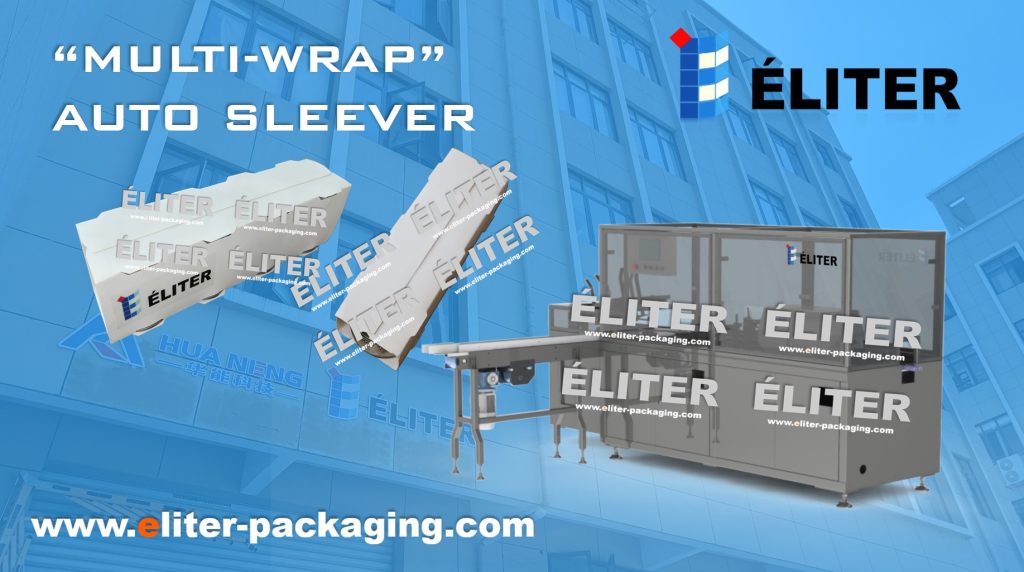
ELITER Packaging Machinery has recently introduced their latest auto sleeving machine for multipack packaging, designed to streamline the packaging process with enhanced efficiency and precision.
This state-of-the-art machine is equipped with advanced automation technology that ensures consistent and accurate application of sleeves on multipack products such as drinks, beverages, and canned food. The new model features high-speed operation, allowing for rapid throughput while maintaining the integrity and appearance of the packaging. It also incorporates user-friendly controls and customizable settings, enabling easy adjustments to accommodate various product sizes and packaging requirements.
With an emphasis on reducing material waste and improving overall productivity, ELITER’s auto sleeving machine represents a significant advancement in the packaging industry, catering to the growing demand for sustainable and efficient packaging solutions.
Multipacking is a packaging method to group numerous units of products from two to twelve, in most circumstances, and them sell them as a whole and as a single package.
Food and beverage companies usually use multipack packaging to sell identical products at once for large quantities and for a discounted price. This happens to those that we eat or drink on a daily basis: Water, economic packs of coca-cola, canned foods and fruit, snacks and dessert pots, microwavable meals… etc.
“
Beverage Multipacking
Credit: ELITER Packaging Machinery
Multipack is often used in the drinks and beverage sector though, the benefits brought by multipacking are not only about sales and promotion yet as well as to meet supply chain and manufacturing needs, for which multipacking is also welcomed in sectors such as pharmaceuticals, personal care, dairy and food, etc.
Multipack packaging usually comes in the pattern of “easy to handle in bulk” and “large secondary packaging”.
Most food and beverage manufacturing companies take the minimization of cost as the primary policy to achieve high efficiency [1]. Multipack packaging helps to control material cost involved for secondary packaging and thus less packaging materials are used.
Warehousing management is a tedious task where countless units of products are to be handled. The multipacking as the secondary packaging can reduce the “units” involved in the process by grouping them into larger units. Such is the benefit brought in terms of the number of items to be handled.
From another point of view, multi-packing helps to organize the storage now that it would be annoying to see mountains in individual products thrown all over.
Consumers no longer have to worry about the mountains of units and items within their carts. Multipack packaging allows people to pick more at once as well as to enjoy the discounted price given by economic multipacking.
To start with a general classification, all methods for multi-packing are no other than the two as follows:
When it comes to the plastic approach, there are basically two options:
Shrink wrapping has been the common packaging protection method in the food and beverage sector for multipack during the past long term.
The shrink-wrapping approach to multipack packaging involves wrapping flexible and thermal-contraction plastic film around the articles. Shrink wrapping is flexible due to its feature to fit whatever shape or size of the products to be wrapped. This is one of the reasons that it reaches to be so popular for multipack secondary packaging.
Shrink wrapping can be applied to products of whatever shapes and sizes: from tin cans, bottles of water, bottles of shampoo, to regular carton boxes,

In difference to shrink wrap which applies simply a piece of plastic film and heats them to shrink, overwrapping follows a more complex process due to the tuck-and-fold features. What’s more, overwrapping is basically restricted to regular carton boxes, and can not be used for those others we mentioned above (shampoo bottles, tins of coca-cola, canned fish, for exmaple).
Overwrapping is in fact not such a popular approach to multipack packaging. Rather, it is somehow only and frequently used for bundling pharmaceuticals in carton boxes.
There are actually more methods with plastic packaging for multipacks such as plastic rings, and plastic banding. Yet here we would only cover shrink wrapping and overwrapping.
Sustainability has entered into every aspect of business and commerce [2]. Such is why food and beverage companies are now considering saying “Goodbye” to plastic packaging for multipacking. From the consumer’s side, a study has shown that more than half of US consumers are nonetheless highly concerned about the environmental impact of packaging in general.[3]
Food and beverage companies are now turning to cardboard as the eco-friendly alternative to conventional plastic packaging, especially shrink wrapping which has been dominant among supermarket shelves that have had a common sight with the presence of shrink-wrapped canned foods, tins of soda and drinks, and bottles of water.
Such a trend is also followed by the world’s leading packaging companies including Westrock, Syntegon, and Graphic Packaging. Cardboard packaging for multi-packing is now going through the roof.

Sleeve Paper Label Multipack
Let’s take comparison and contrast to give the answer.
Shrink-wrapping, on the one hand, consumes considerable energy now that the packaging should be processed by heat to shrink. Packaging waste and plastic pollution are other factors to consider. This happens as well to plastic banding and plastic rings.
However, with cardboard sleeves, this is not the thing to worry about. Cardboard sleeves can be made from recycled materials and are fine for further recycling after being tampered with. The packaging process of cardboard sleeves consumes less energy than plastic packaging does. Further, companies are now looking into glue-less solutions to avoid the use of adhesive which is also a non-environmentally-friendly factor involved in cardboard packaging, for example, the CarrierKote Paperboard by Westrock, then FlexSleeve and Wrap & Clip Multipack by Graphic Packaging.
To meet both manufacturing companies’ expectations of economic packaging and consumer’s concerns around sustainability, ÉLITER Packaging Machinery offers a full range of packaging machines to provide automation solutions for cardboard sleeve and multipack packaging and allows meal trays, tubs, pots, cups, bottles on our machines with a high level of efficiency and improved stability.
See as follow our options for you:
Contact us for more information and do not hesitate to ask any questions: info@eliter-packaging.com
Since taking over his family business in 2021, Zhiwei Bao has developed hands-on expertise in mechanical engineering, industrial automation and carton-sleeving systems. His involvement in R&D and product strategy has helped ÉLITER build solutions for single packs, multipacks and cluster packs across a wide range of production speeds.
Check Zhiwei Bao's Profile
Owner of ÉLITER Packaging Machinery
Read through the stories about ÉLITER Packaging Machinery and discover what sets us different from the rest of the companies in the niche, from mindset, approaches and focuses, to market positioning.